what crisis weakened andean civilization prior to european contact?
| República del Perú Republic of Peru | ||||||
|---|---|---|---|---|---|---|
| ||||||
| Anthem:"Himno Nacional del Perú" (Spanish) "National Anthem of Peru" | ||||||
| | ||||||
| Capital (and largest urban center) | Lima 12°ii.half dozen′S 77°ane.seven′West | |||||
| Official languages | Castilian | |||||
| Demonym | Peruvian | |||||
| Authorities | Unitary presidential republic | |||||
| - | Acting President | Manuel Merino | ||||
| - | Prime Minister | Ántero Flores Aráoz | ||||
| Independence | from Espana | |||||
| - | Declared | July 28, 1821 | ||||
| - | Consolidated | Dec 9, 1824 | ||||
| - | Recognized | August 14, 1879 | ||||
| Expanse | ||||||
| - | Total | ane,285,216 km² (20th) 496,225 sq mi | ||||
| - | Water (%) | 0.41 | ||||
| Population | ||||||
| - | 2010 judge | 29,496,000 (40th) | ||||
| - | 2007 census | 28,220,764 | ||||
| - | Density | 23/km² (191st) 57/sq mi | ||||
| Gdp (PPP) | 2011 gauge | |||||
| - | Total | $299.648 billion[1] | ||||
| - | Per capita | $ix,985[1] | ||||
| Gdp (nominal) | 2011 guess | |||||
| - | Total | $167.846 billion[i] | ||||
| - | Per capita | $5,593[one] | ||||
| Gini (2009) | ▼48[two] (high) | |||||
| Currency | Nuevo Sol (PEN) | |||||
| Time zone | PET (UTC-5) | |||||
| Internet TLD | .pe | |||||
| Calling code | [[++51]] | |||||
| i | Quechua, Aymara and other indigenous languages are co-official in the areas where they are predominant. | |||||
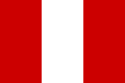

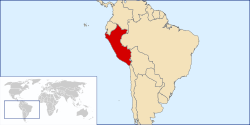
Peru, officially the Commonwealth of Peru, is a country in western South America, bordering the Pacific Ocean. The tertiary-largest country in South America, it is approximately three times the size of California. In improver to being known every bit the cradle of the Inca empire, Peru harbors many indigenous ethnic groups, making information technology a major historical and cultural site. It is besides a land of extremes; from desert in the southwest to rainforest in the northeast and from the mountaintops of the Andes to the depths of Colca Canyon (twice every bit deep equally the Grand Coulee in the United States).
When the Spanish landed in 1531, the Inca empire extended over a vast region from northern Ecuador to central Chile. In search of Inca wealth, the Spanish explorer Francisco Pizarro, who arrived in the territory subsequently the Incas had fought a debilitating civil state of war, conquered the weakened people. The Spanish had captured the Incan upper-case letter at Cuzco by 1533, and consolidated their control by 1542. Gilt and silver from the Andes enriched the conquerors, and Republic of peru became the principal source of Spanish wealth and ability in South America.
Contents
- 1 Geography
- 2 History
- 2.i Ancient cultures
- 2.2 The Incas
- 2.three Colonial rule
- 2.4 Wars of independence
- 2.v Early republican menses
- two.6 War and reconstruction
- 2.7 Mod politics
- 3 Politics
- iii.1 Authoritative divisions
- 3.2 Military
- 4 Economy
- 4.ane Strange trade
- 4.two Foreign investment
- 4.3 Mining and energy
- 5 Demographics
- 5.1 Cultural diversity
- 5.2 Linguistic communication
- five.iii Religion
- vi Civilization
- 6.1 Peruvian artistic creation
- 6.2 Architecture
- vi.3 Art
- 6.4 Music
- 6.5 Dances
- half dozen.half dozen Pop celebrations
- 6.7 Cuisine
- half-dozen.8 Sports
- 7 Notes
- 8 References
- ix External links
- ten Credits
The vice-royalty established at Lima in 1542 initially had jurisdiction over all of the Castilian colonies in South America. By the time of the wars of independence (1820-1824), Lima had become 1 of the nigh distinguished and aloof colonial capitals and the principal Spanish stronghold in the Americas. Subsequently achieving independence in 1821, Peru has undergone periods of political unrest and financial crisis as well every bit periods of stability and economic upswing.
Geography
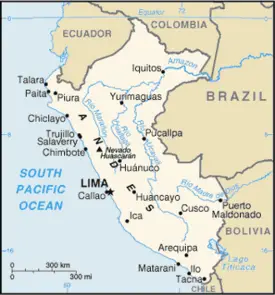
Peru's territory has an area of 496,225 square miles (1,285,216 square kilometers). Information technology is bordered by Ecuador and Republic of colombia on the north, Brazil and Bolivia to the due east, and Republic of chile and Bolivia to the south. To the west lies the Pacific Bounding main. Peru's uppercase, Lima, is located on the coast, about eight miles (13 km) from the Pacific. Lima is home to almost a 3rd of Peru'southward full population, with a full of 2-thirds of the land'southward population living in the coastal region.
In the southeast along the border with Republic of bolivia lies Lake Titicaca — at 12,500 anxiety (3,810 1000) the highest navigable lake in the world. Information technology is 350 miles (560 km) long and 100 miles (160 km) broad and contains xxx islands. The Altiplano plateau is a dry basin located forth the slopes of the Andes in southeastern Peru. Along the border with Chile, the Atacama Desert is the driest identify on the planet.
Republic of peru is divided into three major regions. The western coast contains dry out, desert-like regions to the north as well as to the south, with more agriculturally productive lands forth the major valleys formed by the western-draining Andean rivers. The central Andes run every bit the courage of Republic of peru and are comprised of two large mount ranges with spectacular snow-capped volcanoes and temperate mountain valleys. The average tiptop in the region is around 12,000 feet (iii,660 m). In the northeast, the big region of Amazonian tropical forest has recently been the scene of oil exploration. Peru's tropical forest basin also is the source of three of the major tributaries of the Amazon River: the Ucayali, Huallaga, and Marañón Rivers.
The climate is arid and mild in the coastal expanse, temperate to frigid in the Andes, and warm and humid in the jungle lowlands.
Amidst the animals unique to the Andes are the condor and the llama. The puma, or mount king of beasts, was revered past the Incas as a symbol of strength. The llamas were used by the Incas to behave burdens; and both llamas' and alpacas' wool and hide were used for wear. The vizcacha is a member of the chinchilla family unit.
The rainforest is home to animals including tapirs, jaguars, snakes, monkeys, alligators, and piranhas. Its plant life is also extremely diverse.
History
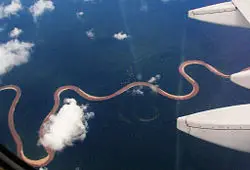
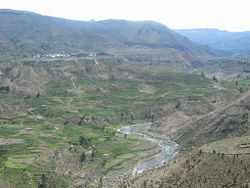
Valle del Colca, Arequipa
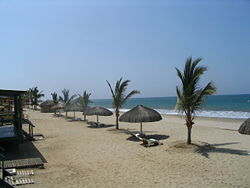
View of the embankment in Punta Sal
Ancient cultures
Archaeological testify indicates that hunter-gatherers have inhabited Peru for nearly twenty thousand years, based on bear witness present in the caves of Piquimachay (Ayacucho), Chivateros, Lauricocha, Paijan, and Toquepala. Some of the oldest identifiable cultures appeared ca. 6000 B.C.Eastward. in the coastal provinces of Chilca and Paracas and in the highlands province of Callejon de Huaylas.
Over the following three thousand years humans became agrarian, judging from sites such every bit Kotosh and Huaca Prieta. Cultivation of plants such every bit corn and cotton began, likewise as the domestication of animals including alpaca and llama. Inhabitants skilful domestic crafts such as spinning and knitting of cotton fiber and wool, basketry and pottery. Some of the more than advanced Andean civilizations that appeared long before the inflow of the Incas were:
- Caral-Supe Civilization (ca. 2500 B.C.East. - )
- Chavin (1000 to 500 B.C.E.)
- Paracas (750 B.C.East. and 100 C.E.
- Mochica (Moche) (flourished 100 - 750 C.E.)
- Tiahuanaco or Tiwanaku (possibly pre-existing the Egyptian Pyramids)
- Nazca (Classic Nazca (approximately 250-750 C.E.)
Other cultures include:
- Wari or Huari (ruling 700 to g C.E.)
- Chimu (ruling 1100 to late 1400s)
These cultures developed relatively advanced techniques of cultivation, metallurgy, aureate and silvery work, pottery, and knitting and weaving. Some had hugger-mugger irrigation systems, and grand monuments constructed of 100-ton stones. Effectually 700 C.Due east. they also developed systems of social system that were the precursors of the Inca civilization.
Not all Andean cultures were willing to offer their loyalty to the Incas as they expanded their empire, and many were openly hostile.
The Incas
The Incas created the near vast and powerful empire of pre-Columbian America. Information technology dominated a territory that included from north to south Ecuador, office of Republic of colombia, the northern half of Chile and the northeast function of Argentina; and from west to east, from Republic of bolivia to the Amazon rainforest.
The empire originated from a tribe based in Cuzco, which became the capital. Pachacuti was the first ruler to considerably aggrandize the boundaries of the Cuzco state. His offspring subsequently ruled an empire by variously tearing and peaceful conquest. The empire's authoritative, political, and military heart was located in Cuzco.
Colonial rule
Francisco Pizarro and his brothers were attracted past the news of a rich and fabulous kingdom. In 1531, they arrived in the country, which they chosen Peru. At that moment, the Inca empire was sunk in a 5-year ceremonious war between two princes, Atahualpa and his brother Huascar. Taking reward of this, Pizarro carried out a insurrection d'état, taking the emperor captive, at which point the Incan army fled. Spanish domination was consolidated as successive indigenous rebellions were brutally repressed. Lima was established in 1535 and became the political and administrative headquarters. With the arrival of the Viceroy Francisco de Toledo in 1572, the Spanish promoted economic development and mineral extraction. He took advantage of the Inca institution of required public service called "mita" (a Quechua term mit'a meaning "season," or "term of labor") to subject the native communities to cruel economical enslavement.
The Viceroyalty of Peru became the richest and most powerful Spanish Viceroyalty of America in the eighteenth century. The creation of the Viceroyalties of New Granada and Rio de la Plata (at the expense of its territory), the commerce exemptions that moved the commercial eye from Lima to Caracas and Buenos Aires, and the decline of mining and textile production adamant the progressive decay of the Viceroyalty of Peru. These events created a favorable climate so that emancipating ideas had an upshot on the Creoles.
Wars of independence
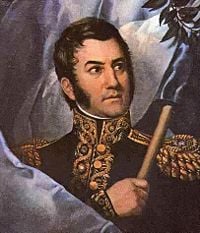
Don Jose de San Martin proclaimed the independence of Republic of peru on July 28, 1821.
The economic crisis favored the ethnic rebellion that erupted from 1780 to 1781. This rebellion was headed past Tupac Amaru Ii. At the time, Napoleon Bonaparte'due south invasion of the Iberian Peninsula and the degradation of royal power took place. The Creole rebellion of Huánuco arose in 1812 and the rebellion of Cuzco arose between 1814 and 1816. These rebellions defended the liberal principles sanctioned by the Constitution of Cadiz of 1812.
Supported by the power of the Creole oligarchy, the Viceroyalty of Republic of peru became the final redoubt of Spanish dominion in South America. This Viceroyalty succumbed subsequently the decisive continental campaigns of Simón Bolivar and Jose de San Martin. San Martin, who had displaced the realists of Chile subsequently the battle of the Andes, proclaimed the independence of Peru in Lima on July 28, 1821. Three years afterwards, Castilian dominion was eliminated definitively after the battles of Junín and Ayacucho. The outset elected president, even so, was not in power until 1827.
Early republican period
The disharmonize of interests that faced dissimilar sectors of the Creole society and the particular ambitions of the caudillos made the organization of the country excessively difficult. Merely three civilians could accede to the presidency in the kickoff 75 years of independence.
Later the splitting of Alto Peru in 1815, Bolivia was created. In 1828 Peru fought a war confronting Gran Republic of colombia over control of Jaén and Maynas territory, called the Gran Colombia-Peru State of war. After the state of war, Peru retained control over the territory. This was its first international conflict as a new nation. In 1837, the Republic of peru-Bolivian Confederation was likewise created, but it was dissolved two years later due to Chilean military machine intervention.
Between these years, political unrest continued, and the ground forces was an important political force. Peru initiated a menstruation of political and economical stability in the middle of the nineteenth century, under General Ramon Castilla's caudillista hegemony. The complete depletion of guano, the main foreign currency source, and the War of the Pacific with Chile because of the dispute over the saltpeter deposits of Tarapacá, caused economical bankruptcy and stirred upwardly social and political agitation.
In 1864, Spain organized a so-called naval trek, whose master objective was to recover control of its quondam colonies. Spain started occupying the Chinchas Islands and arresting Peruvian citizens in 1864, claiming that Spaniards were mistreated on Peruvian soil. After that, the Castilian fleet destroyed the Chilean harbor of Valparaiso. Republic of chile, Ecuador, Bolivia, and Republic of peru signed an brotherhood to defeat Spain.
War and reconstruction
In 1879 Peru entered the War of the Pacific, which lasted until 1884. Bolivia invoked its alliance with Peru confronting Republic of chile. The Peruvian authorities tried to mediate the dispute by sending a diplomatic team to negotiate with the Chilean government, but the commission concluded that war was inevitable. Chile declared war on Apr 5, 1879. Almost v years of war ended with the loss of the department of Tarapacá and the provinces of Tacna and Arica in the Atacama region.
After the war, an boggling effort of reconstruction began. Political stability was accomplished merely in the early 1900s. The civilist movement headed by Nicolas de Piérola opposed the military machine caudillismo that arose from the military defeat and economic plummet. He came to power with the 1895 revolution. The reformist character of Pierola's dictatorship had continuity in Augusto B. Leguía's.
During Leguia'southward government periods (1908-1912 and 1919-1930), the entrance of American upper-case letter became general and the bourgeoisie was favored. This politics, along with increasing dependence on foreign upper-case letter, contributed to generating opposition between the landowner oligarchy and more progressive sectors of Peruvian club.
In 1929 Peru and Chile signed a final peace treaty, past which Tacna returned to Peru and Peru yielded permanently the rich provinces of Arica and Tarapaca but kept certain rights to port activities in Arica and a role in decisions over what Chile can do in those territories.
Afterwards the worldwide economic crisis of 1929, numerous brief governments followed one some other in succession. The American Popular Revolutionary Alliance (APRA), a nationalist, populist, and anti-imperialist move founded in 1924, had the opportunity to cause organization reforms by means of political action merely was unsuccessful. By this time, Republic of peru had experienced sudden population growth and an urbanization increase. During Earth War II, Peru was the showtime South American nation to align with the United States and its allies against Germany and Japan.
Modern politics
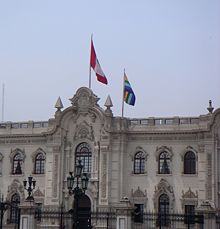
Casa de Pizarro, Republic of peru's Government Palace in Lima
General Manuel A. Odría led a dictatorial military government that lasted for 8 years (1948–1956). Caitiff state tenure and widespread social marginalization provided the impetus in the early 1960s for the emergence of Peru's armed left.
Meanwhile, the reform attempts of Fernando Belaunde Terry'south start government failed to address the structural nature of Peru'southward social problems. His regime embraced numerous projects, including a highway linking the Pacific coast with previously isolated northern regions, merely was perceived every bit existence besides shut to foreign majuscule. Moreover, his economic decisions led to the devaluation of the sol and generalized unrest, both in the countryside and Lima.
In 1968, General Juan Velasco Alvarado led a coup d'etat replacing the Belaunde government. The nationalist and left-leaning tone of Velasco was manifested past his regime's promulgation of Republic of peru's first substantial agrestal reform, which was aimed at stemming the tide of civil unrest, especially in the Andes where land ownership patterns were profoundly inequitable. Velasco'due south government is credited with promoting peasants' rights, including recognition of Quechua as a national language and communal land ownership.
Invariably, this gave rise to conflict with Peru's elite, those with foreign uppercase interests and local oligarchs. Velasco's declining health, inverse global weather, and poor planning resulted in a counter-reaction to his programme. In 1975 General Francisco Morales Bermúdez led a coup d'etat, replacing Velasco as president. Morales Bermúdez's government was characterized by a return to aristocracy-oriented politics, which did petty to stem civil unrest from a populace largely excluded from the social benefits of citizenship.
Frustrated by their inability to "rule" Republic of peru, the Peruvian armed services were forced to telephone call elections. Belaúnde Terry was re-elected every bit president in 1980. However, by the cease of his term, Peru still again faced a crisis that has gripped Peru for the past ii decades: mounting external debt has stymied the actions of successive Peruvian governments. Moreover, Belaúnde was impotent to halt the progressive impoverishment of the vast majority of the population, the massive increase in drug trafficking, or the insurgent revolts of the Maoist Shining Path (Sendero Luminoso) and the Túpac Amaru Revolutionary Motility.
With much optimism, the leader of Peru'southward APRA party, Alan Garcia, was elected president in 1985. Similar his predecessors, when he relinquished power, he left the land in a worse state than when he entered office. The Peruvian economy was crippled by hyperinflation, isolated from the international financial community, and was in the throes of a bloody ceremonious war pitting the Shining Path and the Tupac Amaru Revolutionary Movement confronting the state and its allies. In a climate of generalized chaos, terror, and political violence, Alberto Fujimori was elected in 1990. The virtually unknown university rector narrowly defeated the famous Peruvian novelist and cultural icon Mario Vargas Llosa.
Two years after he was elected, Fujimori summarily closed Congress and convened a referendum to write a new constitution (1992). Credited past sectors of Peruvian gild and the international financial community with restoring macroeconomic "stability" to Peru later on the turbulent Garcia years, Fujimori was widely criticized for what his opponents described as an authoritarian authorities.
Following a controversial third "re-election," amid mounting corruption, widespread political violence, and gross human rights violations, Fujimori was forced to resign. He requested political asylum in Japan based on his Japanese citizenship.
In the turmoil following Fujimori's sharp fall from power, Valentín Paniagua was selected every bit the transitional president. Post-obit a hotly contested election, Alejandro Toledo became president (2001-2006), narrowly defeating García. In 2006, Alan García was in one case again elected president, defeating nationalist candidate Ollanta Humala.
Politics
The formal politics of Peru takes place in a framework of a presidential representative democratic republic, whereby the president is both head of country and caput of government, and of a pluriform multi-party system.
Executive ability is exercised by the regime. Legislative power is vested in both the regime and the Congress. The judiciary is supposed to exist independent of the executive and the legislature.
Authoritative divisions
Republic of peru is divided into 25 regions and subdivided into 180 provinces and 1,747 districts. The Lima Province, located in the fundamental coastal area, is unique in that it doesn't belong to any of the regions. The metropolis of Lima is located in this province, which is besides known equally Lima Metropolitan Area.
War machine
The military branches of the Peruvian armed forces include the army, navy, and air forcefulness. It has the second almost powerful army of South America. In the last few years social stability has brought the army back to its original objectives: control of national sovereignty on the ocean, state, and air, as well as protecting the people, economy, and infrastructure from threats.
Economy
Peru'south economy has shown potent growth over the past five years, helped past market-oriented economic reforms and privatizations in the 1990s, and measures taken since 2001 to promote trade and attract investment. GDP grew viii.0 percent in 2006, 6.seven percent in 2005, 4.eight pct in 2004, 4.0 percentage in 2003, and iv.9 per centum in 2002. President Alan Garcia and his economic team take continued these policies. Gross domestic product was projected to abound by more than 7 percentage in 2007. Recent economic expansion has been driven past structure, mining, export growth, investment, and domestic demand. Inflation is projected to remain under 2 percent in 2007, and the fiscal deficit is only 0.6 pct of Gdp. In 2006 external debt decreased to $28.3 billion, and strange reserves were a record $17.3 billion at the end of 2006.
Peru's economic system is well managed, and better tax collection and growth are increasing revenues, with expenditures keeping pace. Private investment is ascension and condign more wide-based. The government has had success with contempo international bond issuances, resulting in ratings upgrades. The Garcia administration is studying decentralization initiatives and is focused on bringing more small businesses into the formal economy.
Poverty in Peru is high, with a poverty threshold level of 51.2 percent of the full population. However, the level is reducing slowly and it is expected to diminish to 20 per centum of the population within ten years. Per capita Gross domestic product in 2006 was $3,368.
Foreign trade
Peru and the United states signed the U.S.-Republic of peru Trade Promotion Agreement (PTPA) on Apr 12, 2006, in Washington, DC. The PTPA was ratified by the Peruvian Congress on June 28, 2006, and by the U.Due south. Congress on December iv, 2007. On Dec 9, 2006, the U.S. Congress extended the Andean Merchandise Preference Act (ATPA) as amended by the Andean Trade Promotion and Drug Eradication Act (ATPDEA)—jointly referred to as ATPA/ATPDEA—through June 2007. On June xxx, 2007, the president signed legislation extending ATPA/ATPDEA for an additional 8 months.
Peru registered a trade surplus of $viii.8 billion in 2006. Exports reached $23.7 billion, partially equally a consequence of loftier mineral prices. Republic of peru'due south major trading partners are the U.S., Mainland china, EU, Chile, and Japan. In 2006, 23.0 percent of exports went to the U.S. ($5.9 billion) and 16.0 pct of imports came from the U.S. ($two.ix billion). Exports include aureate, copper, fishmeal, petroleum, zinc, textiles, apparel, asparagus, and coffee. Imports include machinery, vehicles, processed food, petroleum, and steel.
Peru belongs to the Andean Community, the Asia-Pacific Economical Cooperation (APEC) forum, and the World Merchandise Organization (WTO). Peru has complimentary trade agreements with the Andean Customs, which is equanimous of Colombia, Republic of ecuador, Bolivia, and Venezuela. Information technology also has gratis trade agreements with many of the countries in Mercosur every bit well as Thailand, and has declared its intention to sign complimentary trade agreements with China, Japan, and Republic of korea. Peru is also seeking a free trade agreement with the European union. These negotiations will greatly aggrandize the markets in which Peruvian products are traded.
Foreign investment
The Peruvian government actively seeks to attract both strange and domestic investment in all sectors of the economy. The U.Southward., Spain, and the United Kingdom are the leading investors. FDI is full-bodied in telecommunications, mining, manufacturing, finance, and electricity.
Mining and free energy
Republic of peru is a source of both natural gas and petroleum. In Baronial 2004, information technology inaugurated operations of the Camisea natural gas project. Camisea gas is fueling an electricity generator and six industrial plants in Lima, and other facilities are in the process of switching to gas. In a 2d phase, liquefied natural gas (LNG) will be exported to the west coast of the U.s. and Mexico. The gas and condensates from Camisea are equivalent to some 2.iv billion barrels of oil, approximately seven times the size of Peru'southward proven oil reserves. The Camisea project, when completed, is expected to gradually transform Peru's economic system, catalyze national development, and turn Peru into a net energy exporter.
Republic of peru is the world's second-largest producer of silverish, 6th-largest producer of gilt and copper, and a pregnant source of the world'due south zinc and atomic number 82. Mineral exports take consistently deemed for the most meaning portion of Peru's consign acquirement, averaging around 50 percent of total earnings from 1998 to 2005 and 62 percent in 2006.
Demographics
With a population of 28,674,757 (July 2007 estimate), Republic of peru is the fifth most populous country in Latin America (after Brazil, United mexican states, Colombia, and Argentine republic). Twenty-one cities take a population of 100,000 or more. Rural migration has increased the urban population from 35.4 per centum of the total population in 1940 to an estimated 74.6 per centum as of 2005.
The overall literacy rate for adults is 87.7 percent (males 93.five per centum and females 82.1 percent by a 2004 estimate).
The median age of the total population is 25.5 years (males 25.2 years and females 25.8 years. Life expectancy at birth for the full population is 70.14 years (males 68.33 years and females 72.04 years by 2007 est.)
Cultural diversity
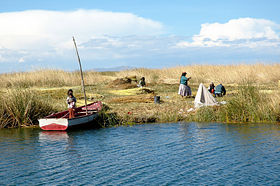
Peru is one of the four Latin American nations with a large population of unmixed indigenous peoples. Around 35 percent of all Peruvians are classified as indigenous peoples, most of whom are plant in the southern Andes, though a large portion are also found in the southern and fundamental declension due to deportation during the civil war (1985-2000) and the massive internal labor migration from remote Andean and Amazonian regions to coastal cities, especially Lima. While the Andes are the "heart" of indigenous Peru, Amazonia's rich biodiversity is matched by the broad diverseness of indigenous peoples residing in the region.
The ii major indigenous groups are the various Quechua-speaking populations, followed closely by the Aymará (mostly plant in the farthermost southern Andes), equally well as dozens of indigenous cultures dispersed throughout the state beyond the Andes and in the Amazon River basin.
A big proportion of Peru's ethnic peoples who live in the Andean highlands still speak Quechua or Aymara and have vibrant cultural traditions, some of which were part of the Inca empire, arguably the well-nigh advanced agricultural civilisation in the world. In the tropical Andes and lowlands of the Amazon, which represents near 60 pct of Peruvian territory, one notes some of the planet'southward greatest cultural and biological diversity.
Peruvian Amazonia is rapidly becoming urbanized yet is dwelling house to numerous ethnic peoples, though they are a minority compared to the total population. These tribes include the Ashianikas, Urarina, Cocama, and Aguaruna, to name just a few.
On the n coast there are still indigenous peoples who are descendants of cultures such every bit the Chimu, Chan Chan, Mochica, Tallan, and Tumpis. All of these tribes were ethnically closely related to loftier jungle Amazonian and Caribbean peoples that migrated here before the Incas-Quechuas conquered the northern regions of Peru and Ecuador. Almost of the surface area had a strong Spanish presence, since nigh of the Spanish settled in the fundamental and n coast and the Andes, so there are few pure indigenous inhabitants on the north coast.
At the national level, mestizos establish the largest segment of the population: 45 pct. The term denotes people of mixed ancestry, be it European with ethnic, African, or Asian. Around three-fourths of the mestizos come up from a mixed ancestry of European (basically Castilian descent) and ethnic descent. The remaining quarter of the mestizo group are of African (blackness) ancestry, with around three percent of Asian (Chinese) ancestry.
Effectually 17 percent of the population is classified equally "white" and are mostly the descendants of Spanish colonizers (called criollos), though in that location are as well descendants of immigrant families like Italians on the central coast, Germans in the fundamental jungle, Chinese in the central-northern coast, and Japanese on the key coast. The majority of the Creole communities live in Peru's largest cities and on the northern declension; in the s, only Arequipa shows of import Spanish influence.
Betwixt 5 and six percent of Peruvians are classified as purely black (Afro-Peruvian); near of them alive in coastal cities south of Lima. Another large segment of Afro-Peruvians is institute w and just below the Andean chain of northern Republic of peru, where sugarcane, lemon, and mango production is still of importance.
In Amazonia, some Afro-Peruvian families trace their origins to workers brought from the British islands of the Caribbean to participate in the safe blast (1880-1920). But the merely Amazon region where there is a visible blackness presence is the Huanuco region and Cerro de Pasco's jungle valleys, since African slaves fled to these tropical valleys from the Andes, where they worked every bit miners.
Republic of peru has the second largest population of people of Japanese descent in Latin America, after Brazil. Many of them traveled to Japan in the 1980s and early on 1990s as the economical state of affairs in Republic of peru worsened. Some, however, returned afterward the election of Peruvian-Japanese Alberto Fujimori equally president in 1990. Peru also has a big community of Chinese descent, mainly living in Lima, where Peruvian-Chinese restaurants (chosen chifas) are commonplace. Historic communities of Chinese people are found throughout the Peruvian upper Amazon, including cities such as Yurimaguas, Nauta, and Iquitos. In contrast to the Japanese community, the Chinese announced to have intermarried much more than. "Unmixed" Asians make upwardly roughly three percent of the population of Peru, the largest percentage of any Latin American nation-country.
Language
Spanish is the official language, also as—in the areas where they are predominant—Quechua, Aymara, and other native languages. Spanish is understood past virtually all Peruvians and is used by government, media, and in education and formal commerce. There has been an increasing and organized effort to teach Quechua in public schools in areas where it is spoken. The major obstacle to more widespread use of Quechua is that multiple dialects exist. Quechua, Aymara and the minor ethnic languages, were oral languages, and essentially remain so. Therefore, there is a lack of print media such as books, newspapers, software, magazines, technical journals, etc., in these languages. Nonetheless, not-governmental organizations, every bit well as state-sponsored groups, are involved in projects to edit and translate major works into the Quechua language, which appeared in a printed version in 1560 in the form of a dictionary by Domingo de Santo Tomás.
Religion
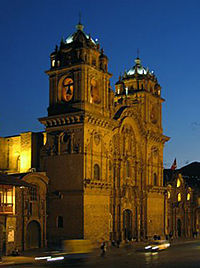
Iglesia de la Compañía, Cuzco
Republic of peru has prided itself on being a Catholic country since the late 1500s. At present, more than 80 pct of the population are Roman Catholics; most of the rest belong to Protestant faiths, the most of import being Evangelists, Adventists, and Mormons. Indigenous communities have also created a symbiotic form of religion that is a popular grade of Catholicism. Mixing Cosmic saints with pre-Hispanic traditions allows them to maintain aboriginal forms of worship under the guise of Catholic rituals. For example, the indigenous banquet of the Inti Raymi (summer solstice) is historic in many communities as the banquet days of Saints Peter and Paul.
Huacas (sacred mountain places) are still deemed sacred deity dwellings that demand the respect and veneration of the indigenous populations. The Spanish Catholic missionaries were very aware of these Andean practices, which is why many Catholic churches were built on top of huacas and other pre-Hispanic temples.
Peruvians' notion of an afterlife very much follows Catholic notions of heaven, purgatory, and hell. Even indigenous groups have been heavily influenced by the Christian notions of Armageddon and rebirth. In Indian communities there are long-standing traditions of millenarians and of the second coming of the Inca ruler to punish the white colonizers. This symbiotic Christian/Andean second-coming myth initially gained strength in the resistance motion of Tupac Amaru that challenged Spanish colonialism in the seventeenth century.
Civilization
Similar its rich national history, the pop civilisation of gimmicky Republic of peru is the issue of a fusion of cultures, constituted primarily from the cultural legacy of the indigenous groups, and Spanish and African colonists. This cultural mixture has been further enriched by the contributions of other immigrant groups, especially Asians and not-Iberian Europeans.
Peruvian artistic creation
Peruvian cultural patrimony has its origin in the magnificent Andean civilizations, which flourished before the Spaniards' arrival. Republic of peru'due south archaeological treasures are evidence of many pregnant achievements comparable to those of other great civilizations.
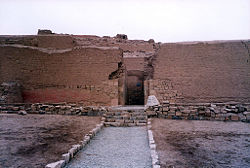
The Pachacamac Temple. The photo was taken in 2002.
Some of the first artistic manifestations reflecting more avant-garde intellectual and technological development are artifacts found in the deposits of Chavín de Huántar and Cupisnique. These are examples of symbolic and religious art including gilt and silver work, ceramics, compages and stone sculpture. These sites appointment every bit far back every bit the fourteenth century B.C.E. and eleventh century B.C.Due east., respectively.
Betwixt the 8th century B.C.E. and get-go century C.E., the Paracas Cavernas and Paracas Necrópolis cultures adult. The Paracas Cavernas culture produced beautiful polychrome ceramics with religious representations as well as monochrome ceramics. The Paracas Necrópolis civilization is characterized by its delicate fabrics in complex styles.
In the period between the 3rd century B.C.E. and seventh century C.E., the urban culture known every bit Mochica developed in Lambayeque. Nazca culture also adult in this menstruation in the valley of río Grande, in Ica. In Mochica civilisation, the magnificent Huaca del Sol and Huaca de la Luna and the Huaca Rajada of Sipan are worth mentioning. They are notable for their cultivation in terraces and hydraulic engineering, likewise as some of the nearly original ceramics, textiles, and pictorial and sculptural art in the Andean world.
The Wari civilization, which flourished between the 8th century and twelfth century C.E., was based in Ayacucho. This civilization may have been the first Andean culture to define a planned urban layout. Such a concept was later expanded to zones like Pachacamac, Cajamarquilla, Wari Willca, and others. Tiahuanaco culture developed past the borders of Lake Titicaca betwixt the ninth and thirteenth centuries. This civilisation introduced awe-inspiring lithic compages and sculpture as well as military urbanism. These advances in architecture were possible due to the discovery of statuary for making tools.
The Chimú town improved on the principle of urban architecture. This civilization built the city of Chan Chan in the valley of the Moche river, in La Libertad, between the fourteenth and fifteenth centuries. The Chimú were besides practiced goldsmiths and fabricated remarkable works of hydraulic engineering.
The Inca Civilization incorporated, and in many cases perfected, many of the cultural techniques of the civilizations that preceded it. There are many examples of original Inca compages and applied science that have outlasted later Castilian colonial structures. In this regard, the rich Inca heritage can nonetheless be observed in cities like Cuzco, the fortress of Sacsahuaman, Ollantaytambo, Machu Picchu, and extensive stone roads that united Cuzco with the four cardinal points of the Inca Empire. The Castilian conquest displaced, not without violence, native creative practices and concepts, although in many cases, it fabricated for enriching hybrids of traditional Castilian and native fine art.
Architecture
Peruvian architecture is a conjunction of European styles exposed to the influence of indigenous imagery. 2 of the most well-known examples of the Renaissance period are the Cathedral and the church of Santa Clara of Cuzco. Later on this flow, the mestization reached its richer expression in the Baroque. Some examples of this Baroque period are the convent of San Francisco de Lima, the Church of the Compañía and the facade of the Academy of Cuzco and, overall, the churches of San Agustín and Santa Rosa of Arequipa, its more cute exponents.
The independence war left a artistic emptiness that Neoclassicism of French inspiration could make full. The twentieth century is characterized by eclecticism. The best example is San Martin Plaza in Lima.
Fine art
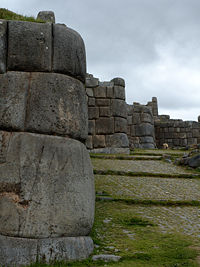
The Inca stonghold of Sacsayhuaman near Cuzco
The fine art of Peru was shaped by the melting between Spanish and Amerindian cultures. During pre-Columbian times, Republic of peru was one of the major centers of artistic expression in the Americas, where pre-Inca cultures developed high-quality pottery, textiles, jewelry, and sculpture.
Drawing upon the earlier cultures, the Incas continued to maintain these crafts but made even more impressive achievements in architecture. The mountain boondocks of Machu Picchu and the buildings at Cuzco are excellent examples of Inca architectural pattern.
During the colonial period, the Spanish bizarre fashion fused with the rich Inca tradition to produce mestizo art. The Cuzco school of largely bearding Indian artists followed the Spanish baroque tradition, with influence from the Italian, Flemish, and French schools.
The early on twentieth century brought "indigenismo," expressed in a new awareness of Indian culture. Since Earth War II, Peruvian writers, artists, and intellectuals have participated in worldwide intellectual and artistic movements, drawing especially on U.S. and European trends.
During the 1960s, Fernando de Szyszlo became the main advocate for abstract painting and pushed Peruvian art toward modernism. Promising young artists continue to develop now that Peru'southward economy allows more than promotion of the arts.
Music

The quena is a Peruvian wind instrument, by and large used by Andean musicians
Like its geography, its cuisine, and its various ethnicities, Peruvian music is very diverse. Much of Peru's music is derived from Andean, Andalusian Spanish, and African roots. Modern Peruvian music and Amazon-influenced music is also mutual in Republic of peru.
The Pre-Hispanic Andean musicians mostly used wind instruments and various membranophone instruments such every bit the tinya (hand drum), the wankar, musical instrument of big dimensions, the pomatinyas (made of puma skin, and the runatinyas (made of human skin). The runatinya was besides used in battles.
With the Spanish conquest, new instruments arrived like harps, guitars, vihuelas, bandurrias, lutes, etc. Due to these instruments, new crossbred Andean instruments appeared. Of these crossbred instruments, the Andean harp and the charango are still used. The sounding box of the charango is made of the armadillo's shell.
Cultural crossbreeding did non limit itself to the contact of indigenous and European cultures. The African slaves' contribution was demonstrated in rhythms and percussion instruments. This influence is visible in musical forms like festejo, zamacueca, etc.
Coastal music is rooted in the haciendas and the callejones of cities such as Lima, Trujillo, Chiclayo, Piura, Tumbes, and Ica. It involves a creole version of the Spanish guitar and the famous Peruvian instrument, the Cajon drum.
Dances
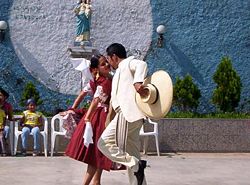
Marinera Norteña, the nearly representative dance on the coast of Peru.
Among dances of native origin, some are related to agricultural work, hunting, and war, while others show Christian influence. Two of the well-nigh representative Andean dances are the kashua and the wayno or huayno. The kashua has a communal character and information technology is usually danced in groups in the country or open spaces. The huayno is a "salon ball" danced by couples indoors. The yaravi and the triste have an Andean origin. They are unremarkably songs with very emotional lyrics.
Dances of ritual character are the achocallo, the pinkillada, the llamerada (a dance that imitates the llama's walk), the kullawada (the spinners' dance), etc. Amid hunting dances, the llipi-puli and choq'elas are dances from the altiplano related to hunting vicuñas.
Some dances of war like the chiriguano have an Aymara origin; the chatripuli satirizes the Spanish Realist soldiers, and the kenakenas is about the Chilean soldiers who occupied Peru during the War of the Pacific (1879). In that location are also Carnival dances. At harvest, many rural communities celebrate youths' initiation with ancestral rites and crossbred dances. New couples might be established.
The most attractive and internationally known Dearest Dance in Peru is the Marinera Norteña. This dance represents a man's courting a young woman. At that place are local variants of this trip the light fantastic in Lima and the other regions of the country.
Pop celebrations
Popular celebrations are the production of every town's traditions and legends. These celebrations get together music, dances, meals, and typical drinks. In addition to religious celebrations like Christmas, Corpus Christi, or Holy Week, others express the syncretism of indigenous beliefs with Christian ones.
Cuisine
Peruvian cuisine, for years unnoticed away, has recently exploded onto the earth gastronomic scene. Peruvian cuisine is a alloy of Amerindian and Castilian roots but has also been influenced by other groups, including African, Italian, Chinese, and Japanese, all of whom have added their own ingredients and traditions to the mix.
Republic of peru'due south many climate zones too make information technology possible to abound a wide range of crops. There are the dozens of native spud, maize, and republic of chile pepper varieties from the Andes, to the plentiful fish and seafood from the Pacific coast, mangoes and limes from the littoral valleys, bananas and manioc from the jungle.
Among the most typical dishes are cebiche, also spelled "ceviche" (fish and shellfish marinated in lime juice; chupe de camarones (a soup made of shrimps; the anticuchos (roasted beef heart); the olluco con charqui (a casserole dish fabricated of ulluco and charqui); Andean pachamanca (meats, tubers, and wide beans cooked in a stone oven); lomo saltado (meat fried lightly with love apple and onion, served with French fries and rice), that has a Chinese influence; and picante de cuy (a casserole dish fabricated of fried guinea pig with some spices). The almost popular ceviche is a type of seafood cocktail where the fish has been marinated in lime juice with onions and hot peppers but non cooked. The lime's acrid precipitates the protein and hence turns the fish white, "cooking" it. In that location are several types of ceviche that include fish only, mixed seafood, mussels, etc.
Sports
The most popular Peruvian sport is football (soccer) (World Cup appearances: 1930, 1970 (quarterfinalists), 1978 (quarterfinalists), 1982 and two Copa America trophies). Most of the population of Peru follow the World Cup tournament on television.
Paleta Fronton, the only sport truly born in Peru, has its roots in "Pelota Vasca" and "Hand Ball." Played with a wooden racquet and a hollow prophylactic ball filled with air, and in a courtroom consisting of a concrete wall and floor, Paleta Fronton is growing in popularity and now is played in Costa Rica and Mexico as well.
Notes
- ↑ 1.0 1.i i.2 i.iii Peru. International Monetary Fund. Retrieved May 6, 2011.
- ↑ Gini Alphabetize. World Bank. Retrieved November xiii, 2011.
References
ISBN links support NWE through referral fees
- Bingham, Hiram. 2002. Lost Urban center of the Incas: The Story of Machu Picchu and its Builders. London: Weidenfeld & Nicolson. ISBN 0297607596
- Buckman, Robert T. 2006. Latin America. World Today Serial. Harpers Ferry, WV: Stryker-Post Publications. ISBN 1887985751
- Falconer, Kieran. 2006. Republic of peru. Cultures of the Globe serial. New York: Marshall Cavendish. ISBN 0761420681
- Haas, Jonathan and Winifred Creamer. 2006 "Crucible of Andean Civilization: The Peruvian Coast from 3000 to 1800 B.C.E." Current Anthropology 47(5): 745-775.
- Hunefeldt, Christine. 2004. A Brief History of Peru. New York: Checkmark Books. ISBN 081605794X
- Countries and Their Cultures. Civilisation of Republic of peru www.everyculture.com. Retrieved November three, 2007.
External links
All links retrieved March 10, 2019.
- Encyclopaedia Britannica - Republic of peru's State Page
- Volunteer in Peru www.cadip.org.
- Peru country-information.com page
Credits
New World Encyclopedia writers and editors rewrote and completed the Wikipedia article in accordance with New Globe Encyclopedia standards. This commodity abides by terms of the Creative Commons CC-by-sa 3.0 License (CC-by-sa), which may exist used and disseminated with proper attribution. Credit is due nether the terms of this license that can reference both the New World Encyclopedia contributors and the selfless volunteer contributors of the Wikimedia Foundation. To cite this article click here for a list of acceptable citing formats.The history of earlier contributions by wikipedians is attainable to researchers here:
- Peru history
The history of this article since information technology was imported to New World Encyclopedia:
- History of "Peru"
Note: Some restrictions may apply to use of individual images which are separately licensed.
Source: https://www.newworldencyclopedia.org/entry/peru

Post a Comment for "what crisis weakened andean civilization prior to european contact?"