Is It Normal for a Broken Gas Gauge to Start Working Again

Home, Machine Repair Library, Auto Parts, Accessories, Tools, Manuals & Books, Machine Web log, Links, Index
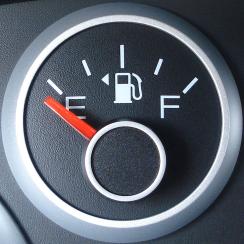
Diagnose Fuel Gauge
past Larry Carley copyright 2019 AA1Car.comNothing is more than aggravating than a fuel guess that doesn't requite an authentic reading, especially when the gauge shows there'southward notwithstanding fuel in the tank when at that place really is not. Faulty readings can be acquired by a bad sending unit, a problem with the gauge, or shorts, opens or weak connections in the wiring that links the two together. But which one is information technology?
In 1904, the outset float arm gas guess appeared. A float mounted on a hinged arm moved a mechanical pointer on judge on the exterior of the fuel tank to indicate the fuel level. The thought was taken one pace further when vehicles started to go better electric systems by connecting the hinged float arm to a rheostat. This allows an electrically operated fuel estimate to be mounted in the vehicle'south dashboard. And that's the basic operating principle that is still in use today.
In that location are substantially three types of fuel gauges: analog resistance (used almost universally up through the early 1980s), analog magnetic (introduced in the '80s) and digital/graphic electronic gauges (as well introduced in the '80s and used to this 24-hour interval).
ANALOG FUEL GAUGES
Analog fuel gauges use a heated bimetal strip to move the indicator needle on the fuel guess. The corporeality of current flowing through the gauge heats upwards the bimetal strip. The strip expands and determines how far the needle moves. Voltage is supplied to the gauge past a small voltage regulator in the instrument panel which reduces excursion voltage to almost v volts. The voltage regulator besides supplies the temperature and oil force per unit area gauges.
The amount of current that flows through the fuel guess is controlled by the ground circuit provided by the sending unit in the fuel tank. Equally the fuel level inside the tank goes upwardly and down, the hinged arm that's attached to the float rotates a rheostat. This changes the corporeality of resistance in the ground circuit which allows more or less current to flow through the judge.
In Ford and Chrysler applications, the sending unit increases resistance as the fuel level drops and decreases resistance as the fuel level goes up. When the fuel tank is empty, for example, resistance is high (around 73 ohms). Loftier resistance reduces the current that flows through the fuel gauge, producing little or no movement in the needle. When the fuel tank is full, the sending unit has low resistance (around 8 ohms) so more current flows through the fuel gauge. This heats upwardly the bimetal strip causing maximum needle deflection. At present the needle moves all the way to the full marking.
A shorted sending unit or a short in the wiring between the sending unit and gauge would reduce excursion resistance causing the fuel estimate to read full. And with nothing to slow the amps, the excursion would probably overload and accident a fuse. An open in the sending unit or wiring, on the other hand, would foreclose the needle from moving at all and the gauge would read empty.
With General Motors analog resistance fuel gauges, the basic operating principle is the aforementioned but electrically opposite. Resistance in the sending unit decreases as the fuel level drops, and increases and the level goes up. When the tank is empty, the sending unit of measurement reads about zero ohms, and when the tank is total information technology reads nigh 90 ohms. Gauge operation is besides the same with maximum needle deflection respective to minimum resistance in the sending unit. In this instance, maximum deflection is required to motility the needle all the manner over to the empty mark.
A short in the sending unit or wiring on a GM system would crusade the fuel judge to read empty, therefore, while an open in the sending unit circuit would make the gauge read total.
MAGNETIC FUEL GAUGES
The successor to the resistance type fuel gauge is the magnetic fuel approximate. Instead of having a heated bimetal strip to deflect the indicator needle, the base of the needle has a small magnet that "floats" in a magnetic field created past 3 coils. The coils are fed voltage through a terminal that's commonly marked "B+" on the back of the gauge. Within, the voltage follows a split up path. Part of information technology passes through all 3 coils to ground and role of it goes through only the commencement coil then on through the sending unit to footing. Depending on the resistance in the sending unit excursion, the strength of the magnetic field created by the start whorl compared to the other two shifts the magnetic field one fashion or the other to deflect the needle on the fuel approximate.
The primary advantages of magnetic gauges (fuel equally well as temperature and oil pressure) compared to the resistance diversity are faster response and more accurate readings. The resistance variety tin take upward to 2 minutes to answer to a alter.
The sending unit that's used with a magnetic fuel gauge is essentially the same as before but with college resistance values. And nigh follow the GM format of high resistance when the tank is full. On a 1980s vintage Chrysler application, for example, the sending unit reads 145 ohms when the tank is full and 22.5 ohms when the tank is empty.
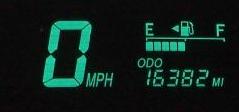
Digital gauges may non be as accurate as analog gauges.
The fuel level shown is a calculation based on the sending unit of measurement input.
ELECTRONIC FUEL GAUGES
Electronic fuel gauges use vacuum fluorescent or LCD graphic displays to point the fuel level. Many also read E, one/two and F. Electronic displays normally accept their own self-contained voltage regulator in the fuel guess control module. The basic operating principle for electronic fuel gauges is essentially same every bit that of the other two types in that the tank mounted sending unit of measurement produces a variable resistance ground path. The module monitors the current through the sending unit and decides which display circuits to energize to bear witness the fuel level.
Virtually electronic fuel gauges have express cocky-diagnostics. When the key is turned on, nigh units light up all their display pixels as a way of checking the display itself (like a seedling cheque). Others get a step further. On Ford, for example, the fuel gauge will flash if the module detects an open up or brusk in the sending unit circuit.
LOW FUEL WARNING LIGHT
Low fuel warning lights are worth mentioning because they're wired into the fuel gauge. On Fords, for example, a depression fuel alarm switch assembly illuminates a warning light when the fuel estimate reads beneath 1/four full. On belatedly model electronic fuel gauges, the lite typically comes on when there is about 1-i/2 to 2 gallons of fuel left in the tank.
FUEL Guess DIAGNOSIS
If the fuel gauge does not modify (always reads the same, always reads empty or full), or behaves erratically, the list of possible causes include a defective voltage supply to the gauge (musical instrument voltage regulator), a bad guess, a lacking sending unit, a wiring problem between the gauge and sending unit of measurement, or a poor ground connection.
If the temperature and oil pressure gauges are besides affected, the problem is not in the fuel approximate or sending unit of measurement. Information technology is in the musical instrument voltage regulator or musical instrument panel wiring. To go at the voltage regulator, you have to remove the instrument panel.
Check the voltage output of the regulator with a volt meter. If it isn't within specs (normally around five volts), it may accept a weak basis connection or an open in the resistor wire that supplies it voltage. Refer to a store manual for the resistance wire specs. and where to discover and check the regulator.
If only the fuel gauge is interim up, you can rule out the voltage regulator as a possible cause. The problem is either in the gauge itself, the sending unit or the wiring in between.
It makes no divergence whether you start with the fuel approximate or the sending unit to begin your diagnosis. The all-time advice is to start with which always one is the nigh easily accessible. If y'all have to drib the fuel tank to become at the sending unit, you can save yourself some effort by starting with the fuel judge. But if the sending unit connector can be reached without having to drop the tank, then start there.

The fuel level sending unit inside the fuel tank
can sometimes stick giving a false indication to the fuel gauge.
It may read loftier or it may read low.
If it reads high, you lot might run out of gas!
FUEL GAUGE SENDING UNIT CHECKS
There are several ways to observe out whether or non the sending unit is doing its chore. One is to unplug the sending unit connector and hook your ohmmeter up to the sending unit terminals. Note the resistance reading. If it isn't within the range of minimum and maximum specs, you've establish the trouble. Replace the sending unit.
To tell how much fuel is in the tank, yous can remove the gas cap and slide a piece of wire or dowel rod downwardly the filler neck like a dipstick. Needless to say, you'd better non have a cigarette dangling from your lips when y'all do this or your widow will be reading your obituary in the newspaper. You don't need an exact indication, merely an approximation. Or yous tin can drain the tank or make full information technology up, checking the resistance readings before and afterwards to see if the sending unit makes the appropriate response.
Another culling is to remove the sending unit from the tank and bench test it using an ohmmeter. Moving the float back and forth between the full and empty positions should produce a corresponding change in resistance. On Ford, for example, the sending unit should read betwixt 8 and 12 ohms when the float is at the full position, and lx to 86 ohms when it's at the empty position. No alter, "skips" in the reading or readings that are out of range would all tell yous a new sending unit is needed.
NOTE: "Bad gas" can occasionally cause fuel sending unit failures. The amount of sulfur in the fuel may corrode the contacts on the sending unit of measurement, causing expressionless spots or a loss of indicate. Bad gas can also cause fuel pump failures.
Nonelectrical bug that can affect the sending unit include a leak in the float (it volition sink or read low), a binding or broken bladder arm, or damage to the fuel tank that prevents the bladder from moving or reading the level accurately.
What if the sending unit checks out okay? Then the problem is in the wiring or the judge. Corroded or loose wiring terminals, opens or shorts in the wiring can be isolated by checking wiring continuity. That leaves the gauge.
FUEL GAUGE CHECKS
Like the sending unit, the guess can exist checked several ways.
1 mode is to remove the sending unit from the tank, reconnect it, plow the key on and movement the float arm upward and downwardly while watching for a modify in the guess reading. If the gauge hasn't responded within a couple of minutes, you've confirmed the fact that you accept a trouble. Simply you lot're still at foursquare one because y'all don't know where it is.
To cheque the approximate, you can simulate input from the sending unit. A examination box that simulates various resistance readings tin can be used in place of the sending unit to test gauge response. Such testers are designed primarily for the older resistance blazon gauges. They include: GM J-24538A, Chrysler C-3826A and Ford 21-0015.
If yous don't have access to a tester for checking your fuel gauge, you can fabricate some resistor jumper wires by buying a five ohm and lxxx ohm resistor at a local radio parts store. Connect each resistor to a fused jumper wire and apply them to simulate high and low sending unit readings. The jumper wires (or examination box) can exist used either at the gauge or sending unit.
If the gauge doesn't respond appropriately when the resistance in the sending unit circuit is changed, check the hot terminal at the judge to come across if it'south receiving voltage. If it is but the needle doesn't move, then it'south fourth dimension for a new gauge.
With resistance and magnetic gauges, you can also check the approximate's internal resistance with an ohmmeter. Yous should by and large find somewhere between 10 to 15 ohms resistance. No resistance would indicate a short in the gauge while very high resistance would betoken an open.
ELECTRONIC Instrument CLUSTER SELF-CHECKS
On many late model cars, the instrument cluster can be put into a self-diagnostic mode to check its internal circuitry. See your owners manual for details, or the factory service literature.
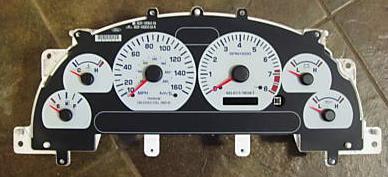
If the fuel gauge in the instrument cluster is faulty,
you usually have to replace the entire cluster.
On a belatedly model Ford Mustang, for case, you tin initiate the diagnostic self-check by pushing and holding the odometer reset button, and turning the key to the ACC (accessory) position. When the word "Exam" appears in the electronic odometer display, release the trip reset button. All of the analog approximate needles will and so sweep from minimum to maximum. When the word "GAGE" appears, push the trip reset button once more, and all the digits in the odometer display will calorie-free up. When the word "Seedling" appears, push the reset button again to illuminate all the bulbs and alarm lights in the cluster. Keep repeating this, and later iii or iv cycles the odometer volition display "DTC" followed by any lawmaking numbers for faults it has detected.
Here is a list of the Ford instrument cluster codes:
9202 Fuel sender open up excursion
9204 Fuel sender brusk to ground
9213 Anti-theft number of programmed keys is below minimum
A103 or 9232 Antenna not continued-defective transceiver
9317 Bombardment Voltage high
9318 Bombardment voltage low
9342 ECU is defective
9356 Ignition run circuit open
9364 Ignition Showtime circuit open
9600 PATS Ignition Cardinal Transponder Signal is Not Received - Damaged Key or not-PATSKey
9601 PATSReceived Incorrect Key-Code from Ignition Cardinal Transponder (unprogrammed Encoded Ignition Key)
9602 PATS Received Invalid Format of Primal - Code From Ignition Fundamental Transponder (Partial Central Code)
9681 PATSTranceiver Bespeak is Non Received (Not Connected, Damaged, or Wiring)
A139 PCM ID does non match between Instrument Cluster and PCM
A141 NVM Configuration Failure (No PCM ID exchange between Instrument Cluster and PCM)
A143 NVM memory failure
5284 Oil Pressure Switch Failure
D027 SCP Invalid or Missing Data for Engine RPM
D041 SCP Invalid or missing data for Vehicle Speed
D043 SCP Invalid or missing data for Traction Control
D073 SCP Invalid or missing data for engine coolant
D123 SCP Invalid or missing data for Odometer
D147 SCP Invalid or missing data for vehicle security
D262 Missing SCP bulletin.
If an electronic gauge cluster is not reading correctly or display segments are expressionless, the only fix is to find a service online that specializes in rebuilding electronic musical instrument clusters (practice a Google search for "automotive instrument clusters", or replace your quondam cluster with a new or used unit of measurement.
 More Fuel System Articles:
Troubleshoot Electronic Musical instrument Cluster More Fuel System Articles:
Fuel Pump Diagnosis
Fuel Pump Diagnosis Tips from Carter
Fuel Pump (how to replace in-tank pump)
Electric Fuel Pumps
Fuel Pump (mechanical)
Bad Gasoline Can Cause Performance Problems
Bad Gas Update 2006

Be sure to visit our other websites:

Auto Repair Yourself
CarleySoftware
OBD2HELP.com
Random-Misfire.com
Browse Tool Help
TROUBLE-CODES.com
Source: https://www.aa1car.com/library/fuel_gauge_diagnosis.htm

Post a Comment for "Is It Normal for a Broken Gas Gauge to Start Working Again"